Research & Learning Series / Eight Volumes

u-he Sound Design Atlas

Electronic Sound Through Instruments, Idioms, Structures & Practice

An eight-volume research program mapping the structures, practices, instruments, and musical idioms of electronic sound design.

Sound design is not primarily the memorization of synthesizer controls. It is the acquisition of a way of hearing.

The Atlas approaches electronic sound through the musical vocabularies in which that sound has developed—genre by genre, idiom by idiom—then investigates how those vocabularies can be constructed, varied, and extended inside u-he instruments.

The result is a systematic study of electronic sound: its structures, instruments, histories, production practices, and musical uses.
Governing Principle

“The reader should be able to use an idea before fully understanding it, understand it before analyzing it, and analyze it without analysis becoming a prerequisite for musical use.”

u-he Sound Design Atlas Monographic Research Series
P1Lab
01 / A Different Starting Point

Start with what the ear recognizes.

Most synthesis education moves from technology toward music: oscillator, filter, envelope, modulation, patch. The Atlas moves in the opposite direction—from recognizable musical sound toward the architecture that produces it.

From Hearing to Construction

Sound first. Architecture second.

A musician rarely begins by wanting a specific frequency ratio or modulation index. They hear something and ask how it behaves, and how something like it could be made. The Atlas begins with that question and works outward into the tools and principles that answer it.

01 / Musical Vocabulary

Genre and idiom provide the evidence.

Genres and idioms supply the evidence. Sound-design problems supply the questions. The u-he instruments provide a practical environment in which those questions can be heard and investigated.

02 / Transferable Judgment

Skills should travel beyond the software.

The goal is not software mastery for its own sake. It is the development of musical judgment that travels across tools, environments, architectures, and genres.

02 / The Eight Volumes

Eight books. One connected vocabulary of electronic sound.

A complete curriculum spanning foundational synthesis, historical and contemporary genre vocabularies, texture and space, generative systems, and modern production practice.

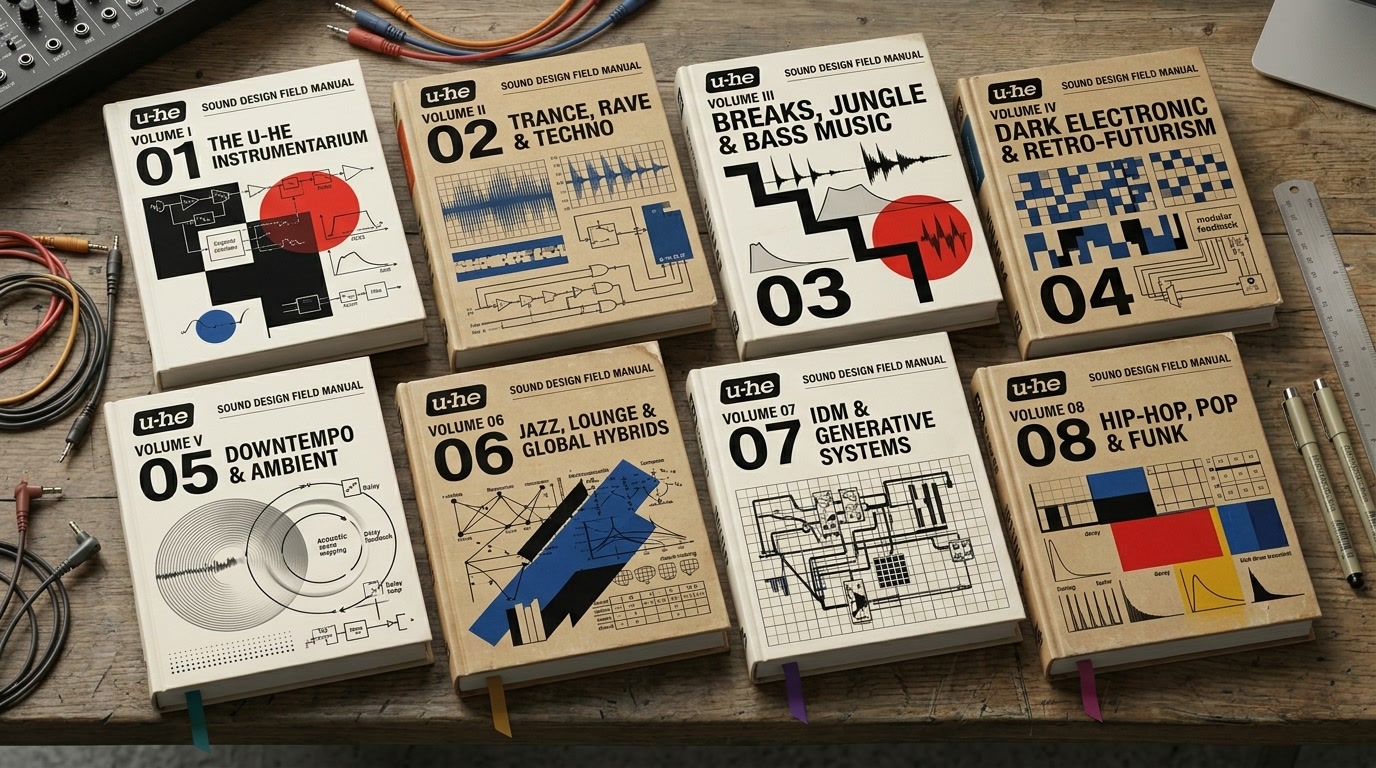
Design comp showing the complete eight-volume physical u-he Sound Design Atlas set on a workbench.
Physical Volume Architecture / Complete Series

Preliminary design comp for the complete eight-volume physical Atlas.

I

The u-he Instrumentarium

Foundational Synthesis · Architecture · Utility & Soundtrack

Establishes the shared vocabulary for the series: oscillation, waveform, filtering, resonance, envelopes, modulation, feedback, phase, FM, wavetable synthesis, multi-stage envelopes, performance control, and spatial behavior.

II

Trance, Rave, Techno & Club Music

Rhythmic Electronic Synthesis · High-Energy Production

Techno, Trance, Rave, House, Hardcore, Eurodance, Progressive House, Hardstyle and related idioms as a framework for rhythm, repetition, resonance, propulsion, bass architecture, and modulation.

III

Breaks, Jungle & Bass Music

Transient Dynamics · Bass Synthesis · Rhythmic Complexity

Drum & Bass, Jungle, Dubstep, Breakbeat, UK Garage, Grime, Footwork and Bassline—focused on transient behavior, low-frequency architecture, rhythmic displacement, and spectral density.

IV

Dark Electronic & Retro-Futurism

Historical Electronic Vocabulary · Contemporary Transformation

Synthwave, EBM, Industrial, Darkwave, Chiptune, Electro, Post-Punk and Synth-Pop: how historical electronic vocabularies persist, mutate, and acquire new meanings.

V

Downtempo, Ambient & Cinematic

Texture · Space · Evolution · Acoustic Illusion

Ambient, Downtempo, Soundtrack, Modern Classical, Trip-Hop, New Age, Chillout and Post-Rock—emphasis on duration, atmosphere, spatial perception, evolving timbre, and acoustic environments.

VI

Jazz, Lounge, City Pop & Global Hybrids

Synthetic Acoustic Illusion · Electroacoustic Fusion

Jazz, Fusion, City Pop, Lounge, Bossa Nova, Funk Jazz, Worldbeat, Exotica and Afrobeat: gesture, expression, instrumental imitation, and the boundary between acoustic and electronic sound.

VII

IDM, Experimental & Generative Systems

Complexity · Algorithmic Systems · Unconventional Architectures

IDM, Experimental, Generative Music, Glitch, Musique Concrète, Electroacoustic, Noise and Deconstructed Club—systems in which sound emerges from complexity, probability, and feedback.

VIII

Hip-Hop, Pop, Funk & Contemporary Production

Modern Commercial & Underground Rhythm Production

Hip-Hop, Pop, Funk, R&B, Trap, Disco, Reggaeton and Afrobeats: how synthesis, sampling, and rhythm operate together in contemporary production.
03 / How the Material Is Organized

Encounter the idea. Hear the behavior. Then understand the system.

Each major topic is encountered at successive levels of depth—first as usable sound, then as recognizable behavior, then as something that can be varied, diagnosed, and transferred.

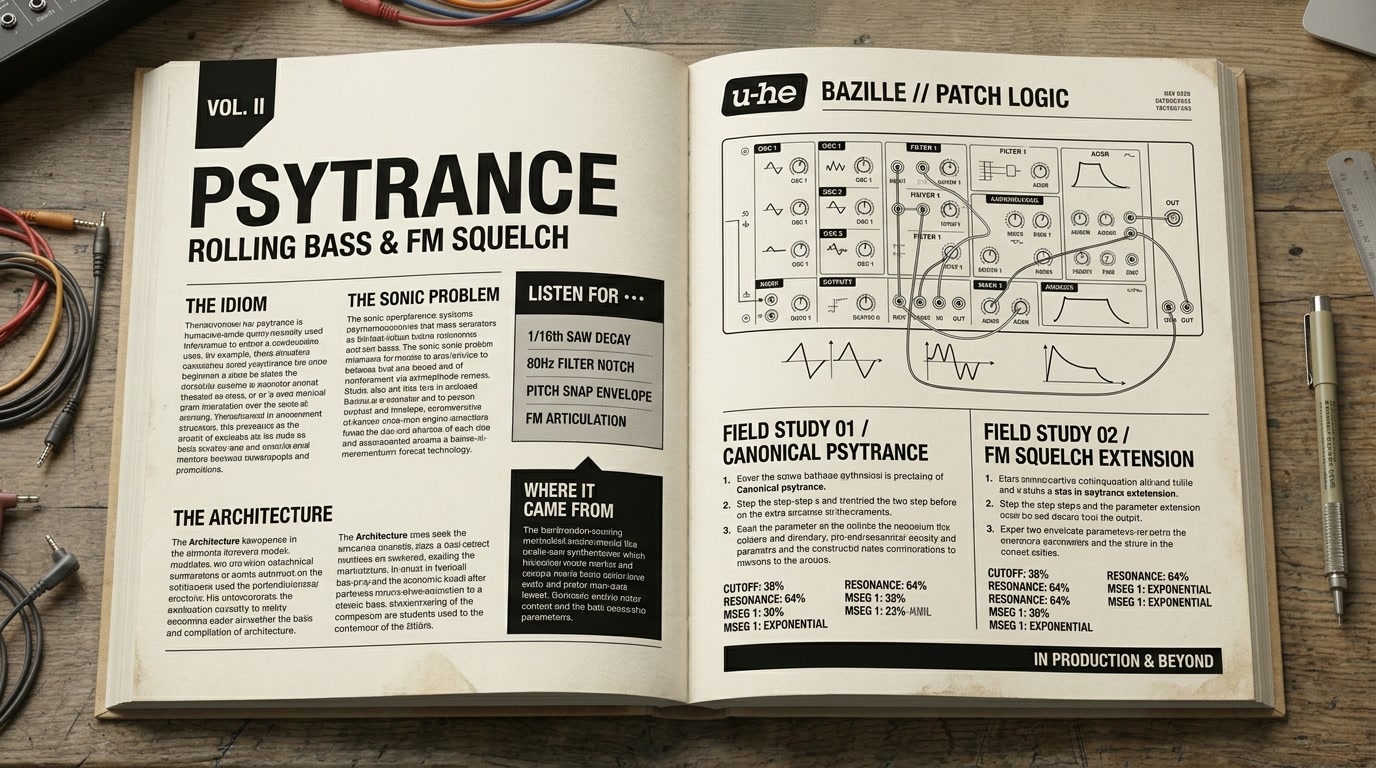
Design comp showing an interior u-he Sound Design Atlas spread with Bazille patch logic and field studies.
Interior Layout / Idiom Definition, Patch Logic & Field Studies

Preliminary interior design comp showing the intended relationship between musical idiom, technical explanation, patch construction, and documentary-style research material.

The reader should be able to begin with the sound and arrive naturally at the architecture behind it.

A reader may first use a filter without understanding resonance, then learn to recognize what resonance sounds like, investigate its behavior, understand why it behaves that way, encounter what happens when it goes wrong, and eventually treat it as a flexible design resource in entirely different musical contexts.

Technical knowledge therefore becomes a consequence of musical investigation rather than a prerequisite for beginning it.

Immediate Musical Result

Investigations open with tangible sonic results so that familiarity is established before technical analysis begins.

Portable Principles

Each section closes with durable principles intended to travel beyond any single instrument or software environment.

04 / The Role of the Presets

Presets are evidence, not the destination.

The practical patches are deliberately limited. They function as evidence and working examples within the research rather than as a standalone preset library.

01 / Idiomatic Example

Make the vocabulary immediately recognizable.

A patch that makes the musical vocabulary immediately recognizable—establishing a clear benchmark for the genre or idiom under study.

02 / Investigative Extension

Push the architecture beyond the obvious result.

A related architecture pushed beyond the obvious genre result, showing what the underlying system becomes when altered or transferred.

The preset demonstrates the principle. The principle is what remains useful after the preset is gone.
05 / u-he as Primary Instrument Environment

One instrument family. Many architectures. A common laboratory.

The u-he instruments provide distinct synthesis environments through which underlying acoustics, architectures, and production techniques can be examined with clarity and consistency.

01 / Comparative Architecture

Universal vs. instrument-specific.

Working across u-he's diverse engines repeatedly raises a useful question: what is universal across electronic sound, and what belongs specifically to a given instrument or architecture? The series treats that distinction as a core research and learning outcome.

02 / Precision

A controlled environment for investigation.

Distinct synthesis architectures provide a consistent practical environment in which the same musical problem can be approached through different technical structures.

03 / Transfer

Learn the principle, then move elsewhere.

The point of working within a defined instrument environment is not dependence upon that environment. The underlying goal is to identify principles that remain intelligible when the tools change.

04 / Evidence

The instrument is a research instrument.

The u-he instruments provide the practical evidence through which the Atlas examines synthesis behavior, musical vocabulary, workflow, and design judgment.

The software is not the subject. Electronic sound is the subject; the instruments are the laboratory.
06 / Institutional & Educational Partnership

Independent research. Curriculum adoption. Educational and industry integration.

The Atlas sits between technical reference, synthesis education, musical history, sound-design practice, and research monograph.

P1Lab develops the u-he Sound Design Atlas as an independent research and publishing program with potential applications in higher education, conservatories, music-technology programs, independent study, and specialist industry training.

The program is structured so that physical books, curriculum materials, specialized modules, and direct institutional engagements can function together without turning the publication into conventional promotional content.

The Atlas is designed as a serious teaching and reference system whose underlying ideas remain useful beyond any single software platform.

Academic & Conservatory Licensing

Complete eight-volume curriculum licensing for music technology, synthesis, composition, and audio-engineering programs.

Institutional Print Editions

Hardbound reference volumes prepared for institutional libraries, laboratories, studios, teaching environments, and specialist collections.

Research Collaboration

Joint initiatives examining acoustic modeling, pedagogical design, synthesis taxonomy, sound-design practice, and related research questions.

Curriculum & Preset Verification

Third-party evaluation of synthesis materials for educational, institutional, or commercial release.

Institutions, educators, and commercial partners interested in adopting the series may request the institutional prospectus.

Request the Institutional Prospectus →
u-he Sound Design Atlas / P1Lab

Learn the sound. Understand the system.

The u-he Sound Design Atlas is an eight-volume independent research and learning series examining electronic sound through musical idiom, synthesis architecture, instrument design, production practice, and transferable judgment.

Contact P1Lab