Independent Documentary Monograph / P1Lab

KOREA: MEDICAL TRAVEL

The Material Culture and Infrastructure of the International Patient

KOREA: MEDICAL TRAVEL is being built to occupy a missing layer in the international-patient journey: the independent, physical trust instrument between discovering Korean medical care and becoming sufficiently confident to act.

Korea does not lack information about its medical system. It lacks a single, independent English-language physical reference that allows an international prospective patient to understand the whole journey — arrival, transportation, communication, hospital coordination, accommodation, recovery, documentation, and departure — as one coherent system.

This publication documents that system.

It is not a medical guide, a hospital review, a tourism brochure, or an investigation of patients. It is an independent documentary study of the material culture, urban form, logistical infrastructure, human interfaces, and commercial systems surrounding the international patient.

The patient journey is larger than the hospital. The record follows the system around it.
Institutional Perspective
00 / The Missing Book

The serious physical reference has become the missing layer.

Modern readers can find information almost everywhere. What is increasingly scarce is the substantial physical book that makes a real place, system, object, or process understandable as a whole.

There is no shortage of information about the world. What is increasingly scarce is the serious physical book that makes a real place, system, object, or process understandable as a whole.

Modern readers can find travel guides, institutional websites, technical manuals, academic studies, promotional material, photography books, videos, databases, reviews, and firsthand accounts for almost any subject. Each can be useful. But these forms tend to divide knowledge into separate purposes: where to go, what something looks like, how it is promoted, how it operates, what experts have concluded, or what one individual experienced.

The neglected space between them is the independent field reference: a substantial physical publication built from firsthand observation, documentary evidence, photography, diagrams, primary knowledge, contextual explanation, and practical understanding. Its purpose is neither to promote the subject nor to impose an author's personal vision upon it, but to make the subject itself legible.

Places

A field book can document a place as a functioning environment — its geography, infrastructure, movement, buildings, interfaces, material systems, history, and human use — rather than reducing it to attractions, itineraries, or photographic impressions.

Systems

A complex system can be examined in the same way: component by component, interface by interface, showing how people, objects, institutions, technology, transportation, communication, and physical environments actually work together.

Objects & Processes

The same editorial method applies to machines, tools, food systems, repair, manufacturing, craft, and other material processes. Photography, diagrams, sequences, terminology, firsthand observation, and practical explanation can turn an unfamiliar object or process into something understandable.

Independent Reference

The resulting book occupies a position between field reporting and reference publishing. It is factual without being bureaucratic, practical without becoming a manual, visual without becoming a coffee-table object, and independent without becoming a personal essay.

P1Lab builds physical editorial platforms for subjects that are important enough to understand, complex enough to require investigation, and poorly served by the existing forms of reference.

01 / The Project

Follow the international patient through the world around care.

A documentary monograph examining what a city must build, coordinate, translate, transport, house, package, explain, and maintain when people cross national borders specifically to receive medical care.

The International Patient as Urban Actor

International medical travel is ordinarily presented through procedures, hospitals, destinations, prices, and outcomes. This study begins somewhere else: with the physical and operational environment surrounding the patient. The international patient enters an airport, crosses a border, enters a vehicle, encounters translated systems, moves through a medical district, occupies a temporary recovery environment, receives objects and documentation, and eventually departs. Each transition requires infrastructure.

2025 Scale

More than two million foreign patients.

South Korea recorded 2,011,822 foreign patients in 2025, according to KHIDI's current reporting. The scale of that activity makes international medical travel not simply a collection of individual transactions, but a visible infrastructural and urban phenomenon.

Central Question

What does a city have to build around medical care?

What does a city have to build, sell, translate, design, transport, house, feed, and explain when millions of people arrive from other countries specifically to receive medical care?

The project follows the international patient through the built and translated world around medical care — not to evaluate the medicine itself, but to document the infrastructure that makes cross-border care possible.

02 / The Trust Bridge

Before action comes understanding.

The central proposition of the publication is that international medical travel requires more than discoverability. It requires confidence in an unfamiliar system.

01 / Information

Information is not the missing layer.

Prospective patients can already find hospitals, procedures, destination information, prices, testimonials, official websites, agency materials, and promotional campaigns. What is less readily available is a coherent independent account of the complete physical experience surrounding international care.

02 / Confidence

Understanding before action.

The publication is designed for the interval between discovering Korean medical care and becoming sufficiently confident to inquire, coordinate, travel, and act. It renders unfamiliar infrastructure visible before the patient has to encounter it personally.

03 / Audience

An English-language international reference.

The project is conceived principally for an international English-language audience: prospective patients, spouses and families, referring professionals, facilitators, institutional decision-makers, and others who influence whether international care is considered viable.

04 / Independence

Independence is part of the utility.

The book does not reproduce institutional advertising. Its usefulness as a trust instrument depends upon documenting the ecosystem independently and allowing the physical evidence of the system to establish its own credibility.

A person should not have to be unusually intrepid to cross a national border for medical care. The system itself should make that decision understandable.

03 / The Patient Journey

The hospital is one node in a much larger journey.

The book follows the international patient through the surrounding infrastructure rather than treating medical travel as a single hospital encounter.

01

Discovery

How Korea and individual institutions become visible to international patients and the networks influencing their decisions.

02

Contact & Coordination

International-patient desks, coordinators, interpreters, digital interfaces, forms, communication systems, and administrative preparation.

03

Arrival & Transfer

Airport interfaces, medical visas, specialized transfers, vehicles, routing, and the first physical movement into the Korean medical system.

04

Medical District

Seoul's concentrated medical geography: districts, clinic streets, hospital zones, vertical buildings, signage, and urban navigation.

05

Recovery

Hotels, recovery rooms, accessibility, food systems, room service, proximity to medical facilities, and the adapted environment surrounding treatment.

06

Objects & Documentation

Packaging, prescriptions, instruction sheets, receipts, labels, pharmacy interfaces, recovery products, and digital systems carried through the journey.

07

Departure

Discharge, documentation, medication and recovery materials, onward transportation, and the physical transition out of the Korean system.

08

The System

The final synthesis: how airport, hospital, translation, hospitality, commercial, and urban systems operate together at city scale.

04 / Research Framework

Thirty-six topics. One connected system.

The study is organized as a 36-topic documentary framework. The topics are deliberately confined to the material culture, urban form, logistical systems, human interfaces, and commercial infrastructure surrounding the international patient.

A · Arrival & Entry Systems
01 — The International Patient as Urban Actor
02 — Incheon Airport as Medical Gateway
03 — The Medical Visa & Border Interface
04 — From Gate to Vehicle: First Physical Transfer
05 — Specialized Medical Transfer Vehicles & Protocols
B · Human & Translation Infrastructure
06 — The Certified Interpreter
07 — The International Medical Coordinator
08 — Translation as Built Environment
09 — The International Patient Desk
10 — Multilingual Wayfinding Systems
C · Urban Medical Geography
11 — Seoul's Concentrated Medical Districts
12 — Gangnam as Medical City
13 — Seocho and Adjacent Medical Zones
14 — The Hospital District as Urban Form
15 — Clinic Streets and Vertical Medical Buildings
16 — The Visual Language of Medical Signage
D · Recovery Environments
17 — The Hotel as Temporary Recovery Infrastructure
18 — Medical-Friendly Room Design & Accessibility
19 — The Recovery Room as Adapted Space
20 — Post-Treatment Food Systems & Room Service
21 — Hotel–Clinic Proximity Clustering
E · Material Objects & Interfaces
22 — The Patient's Carry-Home Assemblage
23 — Pharmaceutical and Medical Packaging Design
24 — Instruction Sheets, Forms, and Administrative Objects
25 — The Pharmacy as Post-Hospital Interface
26 — Recovery Products and Wellness Objects
27 — Digital Interfaces and Translation Technology
28 — Receipts, Labels, and Traceability Artifacts
F · System, Trust & Commercial Architecture
29 — Medical Travel Facilitators as Infrastructure
30 — How Korea Presents Its Medical System Abroad
31 — How Institutions Present Themselves to International Patients
32 — The Visible Architecture of Trust
33 — Continuity from K-Beauty into Clinical Environments
34 — The Scale of the System: What Two Million Patients Means Spatially
35 — Surrounding Tourism, Wellness & Hospitality Networks
36 — The Medical City: An Integrated Urban System

Topic 36 synthesizes the preceding 35 units. Airport gateways, transfer protocols, translation systems, concentrated medical districts, recovery hotels, material objects, facilitators, and commercial networks are examined not as isolated services but as components of a measurable urban and infrastructural system.

05 / Method & Scope

Go there. Observe. Verify. Stay outside the clinical boundary.

Research proceeds through direct observation, primary institutional knowledge, field photography, documentary evidence, and verification. The project remains deliberately on the public, infrastructural, material, and logistical side of the clinical boundary.

01 / Field Observation

See the system in physical space.

Direct observation of airports, streets, buildings, public interfaces, transportation systems, hospitality environments, signage, packaging, pharmacies, and other relevant physical infrastructure.

02 / Primary Knowledge

Ask the people who operate it.

Interviews and institutional research with people responsible for operating, coordinating, translating, designing, transporting, housing, and supporting international patients.

03 / Physical Evidence

Treat objects and interfaces as evidence.

Forms, labels, packaging, signage, wayfinding systems, digital interfaces, administrative objects, architectural details, maps, and other visible artifacts are treated as documentary evidence.

04 / Editorial Restraint

Render the system visible without manufacturing conclusions.

The project does not rank hospitals, assess clinical outcomes, provide medical advice, investigate individual patients, or reproduce confidential medical information. Its purpose is to render the surrounding system visible with accuracy and restraint.

The project is designed so that the large majority of fieldwork can be conducted through normal authorized observation of public and commercially accessible environments. Interior institutional documentation, interviews, and specific facility photography will be undertaken only with appropriate permission.

Zero Patient Data Exposure
No patient identities, personal medical histories, clinical records, or invasive procedure photography are required by the research framework.
Strict Non-Clinical Scope
The publication is an urban, logistical, material-cultural, and infrastructural study—not a clinical review, hospital ranking index, or medical advice publication.
Authorized Fieldwork
Observation and photography will be conducted within applicable institutional, facility, privacy, and fieldwork guidelines. Restricted environments will not be entered or documented without authorization.
06 / The Physical Book

A physical trust-and-reference object.

The finished publication is conceived as a substantial bound reference monograph rather than a disposable marketing publication. Its physical form is part of its function.

Documentary Reference

A record built from evidence.

A designed physical record integrating field photography, primary reporting, institutional knowledge, maps, diagrams, documentary objects, contextual captions, and source records.

Designed for Circulation

A book meant to travel.

The monograph is intended to be owned, shelved, consulted, shared with family members, brought into professional conversations, and retained as a durable reference.

International Edition

Built for an English-language audience.

The primary edition is designed to communicate Korea's international-patient infrastructure to a global English-language readership without reproducing the tone or structure of institutional promotional material.

Fieldwork & Release

Seoul · March 2027.

Fieldwork is planned for March 2027, with a target global publication in Summer 2027.

The publication is designed to function in the hand, in the room, and inside the decision process.
06A / Physical Design Study

The book already has a physical language.

These preliminary visual touchstones show the intended relationship between physical publication, documentary photography, infrastructure, material objects, and structured editorial analysis.

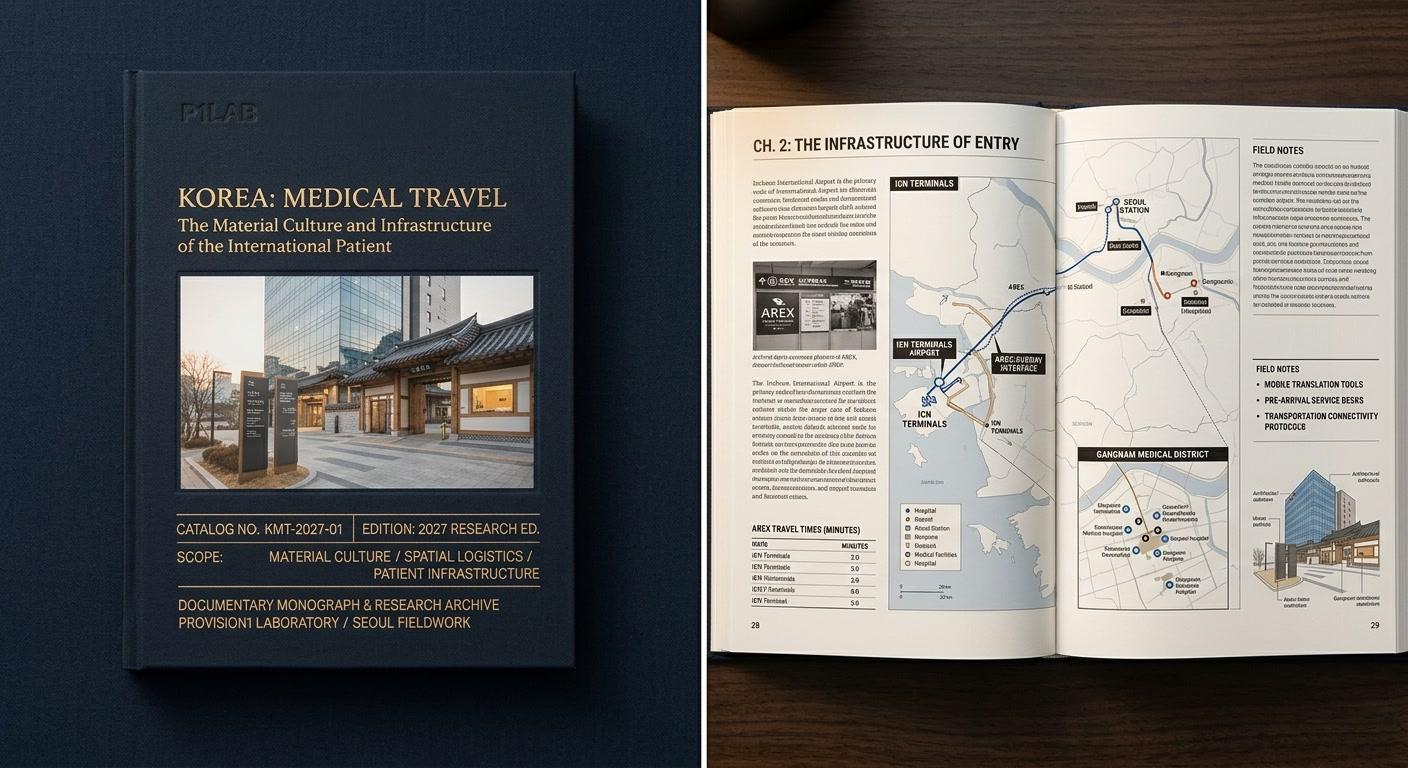
Preliminary physical design study for KOREA: MEDICAL TRAVEL showing the proposed bound monograph.
Physical Design Touchstone · 01

Preliminary design study for the physical form of KOREA: MEDICAL TRAVEL. The publication is conceived as a substantial bound reference object, designed to function in the hand rather than merely on a screen.

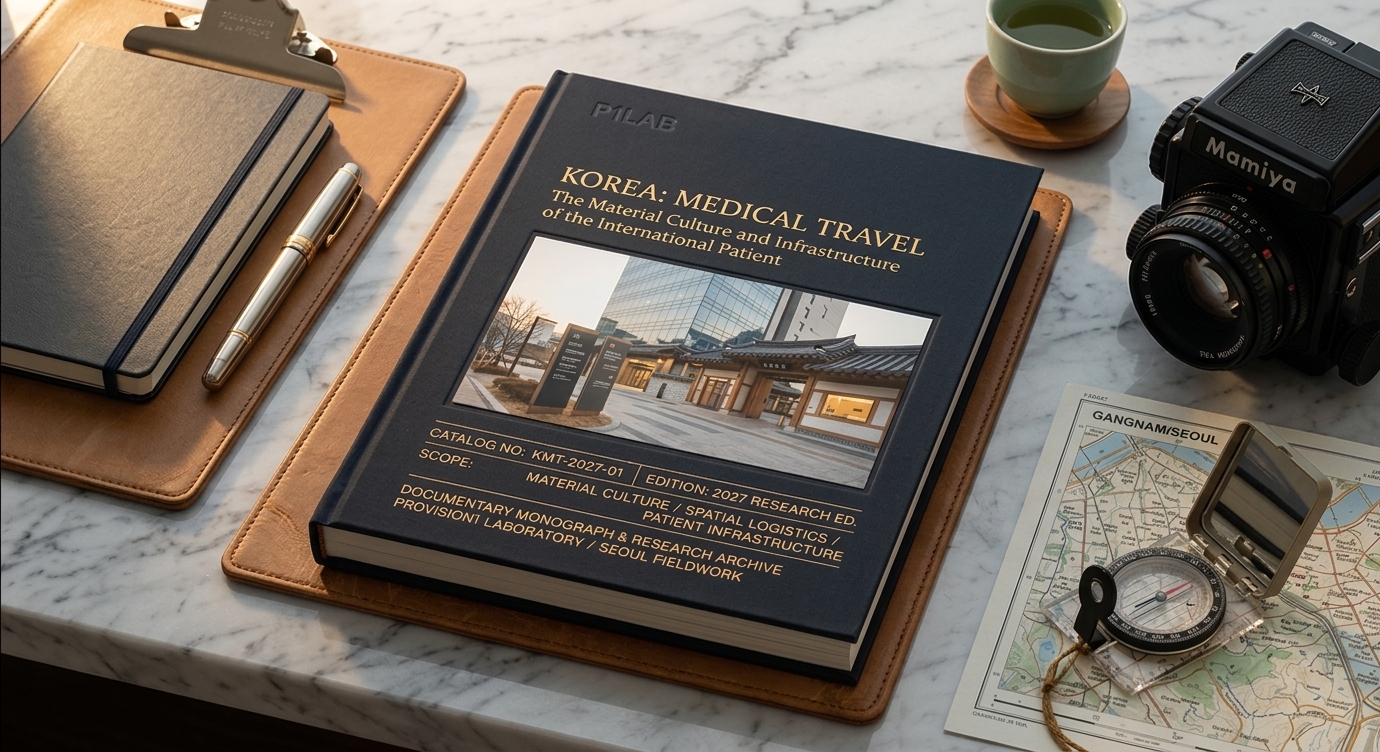
Second preliminary design study for KOREA: MEDICAL TRAVEL showing the physical publication and interior editorial architecture.
Physical Design Touchstone · 02

Preliminary interior design study illustrating the intended relationship between the physical publication, documentary photography, infrastructure, material objects, and structured editorial analysis.

These images are preliminary visual touchstones rather than final production specifications. The final physical architecture, image selection, pagination, paper, binding, and production configuration will be determined as field research develops.

07 / Institutional Participation

Independent publication. Institutional participation. Editorial independence.

The study is building a limited network of organizations whose work forms the international-patient infrastructure documented by the project.

KOREA: MEDICAL TRAVEL is building a limited network of organizations whose work forms the international-patient infrastructure documented by the study.

Participation is structured as an institutional editorial partnership rather than conventional advertising. Participating organizations are documented as operational components of the system: their facilities, interfaces, expertise, services, physical environments, and institutional roles may become part of the published research record.

Participation provides no editorial control over research, subject selection, interpretation, or conclusions. The value of participation is authoritative representation within an independent documentary record.

Founding / Principal Participation

Recognition within the project's institutional framework and master publication record.

Institutional Profile

Structured documentary treatment of the organization's role within the international-patient infrastructure.

Primary-Source Interview

Qualitative institutional knowledge incorporated into the research where relevant to the documentary framework.

Field Documentation

Authorized photography and technical documentation of relevant physical facilities, interfaces, transport systems, or recovery environments.

Published Attribution

Formal institutional acknowledgment within the project prospectus, publication, and associated launch materials.

Finished Reference Copies

Dedicated copies of the completed monograph for institutional, executive, referral, and other appropriate uses.

08 / Institutional Distribution

The finished book enters the ecosystem it documents.

The finished monograph is designed not only to be read, but to be deployed through the international-patient ecosystem.

The book is a physical trust-and-conversion instrument for the ecosystem it documents.

01 / Strategic Circulation

Place the book where decisions are made.

Institutional purchasers may acquire finished copies at wholesale for selective distribution through existing patient-acquisition, referral, hospitality, diplomatic, professional, and international-patient networks.

02 / The Decision Network

Reach beyond the individual patient.

Potential recipients include prospective patients, spouses and families, referring professionals, international-patient coordinators, facilitators, hospitality partners, corporate medical offices, and other decision-making intermediaries.

03 / Distribution Rather Than Advertising

Circulate a reference, not a campaign piece.

The objective is not mass promotional circulation. It is strategic placement of a durable independent reference at points where confidence and understanding influence whether international medical care is seriously considered.

04 / Two Complementary Revenue Streams

Participation and acquisition operate together.

The project combines institutional participation in the documentary record with wholesale acquisition of the finished physical publication. Organizations may therefore participate in the research and representation while also deploying the resulting reference through their own networks.

The organizations that make the system work have a reason to be authoritatively documented within it. The organizations that benefit from international patients have a reason to place the resulting reference into the hands of the people who influence their decisions.

09 / Project Specifications

A defined editorial object with a defined field program.

The project establishes a clear publication framework while leaving the final documentary scope responsive to what field research reveals.

Publication Format

Bound documentary reference monograph organized around a 36-topic editorial framework and a substantial documentary fieldwork archive.

ISBN

978-1-989647-91-2 · Library and Archives Canada

Primary Audience

International patients and their decision networks; global healthcare administrators; medical-travel facilitators; hospitality organizations; institutional and policy audiences.

Fieldwork

Seoul · March 2027

Target Release

May 2027

Editorial Scope

Material culture, urban form, logistics, translation, hospitality, commercial infrastructure, interfaces, and visible systems surrounding international medical care.

KOREA: MEDICAL TRAVEL / P1Lab

Make the unfamiliar system visible.

KOREA: MEDICAL TRAVEL is an independent documentary monograph examining the material culture and urban, logistical, human, and commercial infrastructure surrounding the international patient.

Contact P1Lab